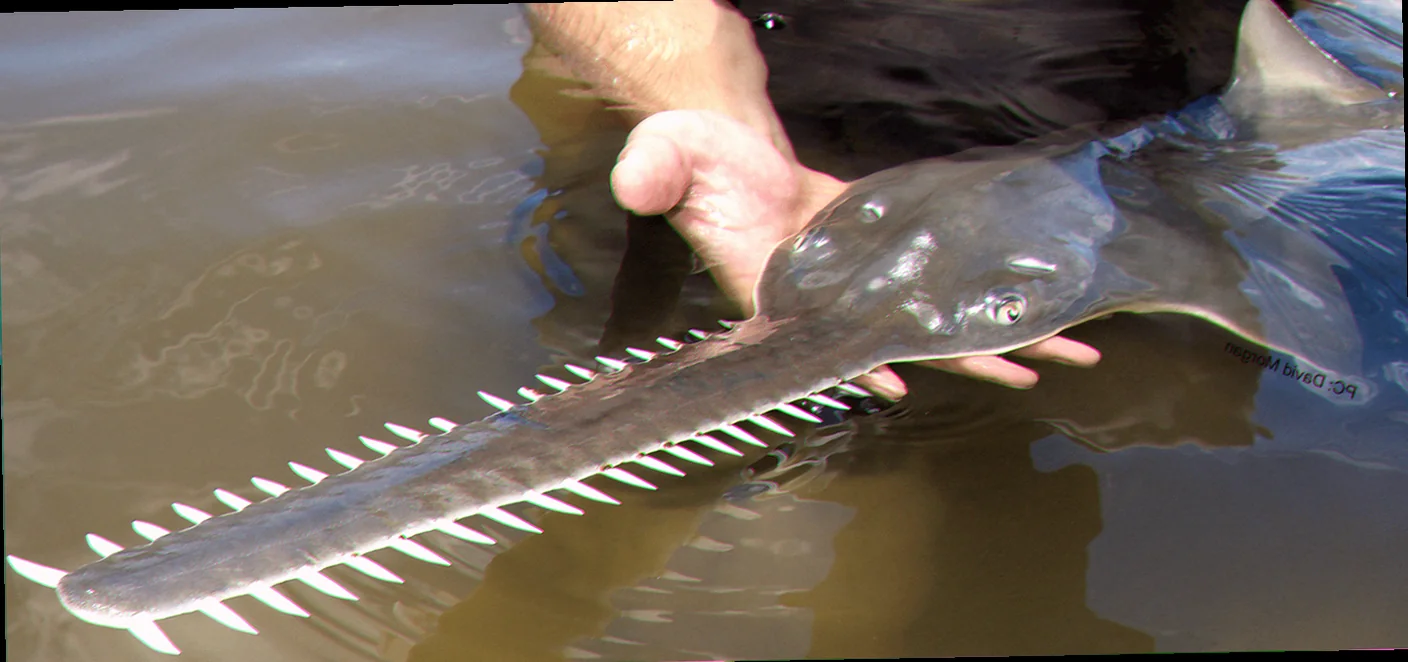
Scientific Classification and Description
Full taxonomy: Kingdom → Phylum → Class → Order → Family → Genus → Species. In Australia, the most commonly studied species belong to the family Pristidae. While several species exist globally, Australian waters are known to host populations of the green sawfish (Pristis zijsron). Adult green sawfish can reach impressive lengths, typically between 3 to 5 metres, with some individuals documented exceeding 6.5 metres. Their weight can correspondingly be substantial, often reaching over 200 kilograms for larger specimens. The distinctive "saw" or rostrum, edged with sharp, tooth-like rostral denticles, can constitute up to 25% of their total body length, with mature individuals often displaying rostra measuring over 1 metre.
Identifying Features at a Glance
| Feature | Detail |
|---|---|
| Scientific name | Pristis zijsron (Green Sawfish) |
| Size (adult) | 3 to 6.5+ metres in length, up to 200+ kg |
| Endemic range | Northern Australian coastal waters, estuaries, and rivers from Western Australia to Queensland. |
| Conservation status | IUCN: Critically Endangered. EPBC Act (Australia): Critically Endangered. |
| Lifespan | Estimated 10-15 years in the wild, with potential for longer in managed environments. |
Habitat and Distribution in Australia
- Primary biome: Tropical and subtropical marine and estuarine environments, including mangrove forests, tidal creeks, coastal mudflats, and freshwater sections of rivers.
- Geographic range: Extends from the Kimberley region of Western Australia, through the Northern Territory, and along the Queensland coast, including the Great Barrier Reef lagoon. They are also found in the Gulf of Carpentaria.
- Microhabitat: Juveniles often inhabit shallow, protected nursery areas within estuaries and mangrove systems, seeking refuge from predators. Adults can be found in both inshore and offshore waters, favouring areas with soft substrates for foraging.
- Altitude / depth range: Typically found from the intertidal zone down to depths of approximately 50 metres, though occasional deeper excursions have been recorded.
- Seasonal movement: While not undertaking long oceanic migrations, sawfish exhibit localized seasonal movements, often moving into rivers during the wet season and returning to coastal areas during the dry season, correlating with changes in salinity and prey availability.
Diet, Hunting, and Feeding Ecology
Sawfish are predatory fish, with their diet consisting primarily of demersal (bottom-dwelling) fish, crustaceans, and cephalopods. They employ a unique foraging strategy: using their saw-like rostrum to stir up sediment on the seafloor, dislodging buried prey. Once a prey item is located, the sawfish will then stun or incapacitate it with rapid side-to-side sweeps of its saw before consuming it. A particularly fascinating and rarely discussed aspect of their feeding ecology is their ability to use their rostral denticles, which are modified teeth, to help filter smaller prey items from the water column or to manipulate larger prey before ingestion, acting almost like comb-like structures.
Reproduction and Life Cycle
The breeding season for sawfish in Australian waters is not precisely defined but is believed to be linked to warmer months, generally between October and March. Sawfish are ovoviviparous, meaning that the eggs hatch inside the mother, and the young develop within the uterus, receiving nourishment from a yolk sac. Litter sizes can vary significantly, with reports ranging from 7 to 23 pups. The gestation period is estimated to be around 6 months. Pups are born with their rostral denticles soft and folded, which harden and unfurl after birth. Age at sexual maturity is poorly understood but is thought to be relatively late, potentially around 10-15 years, contributing to their vulnerability to overfishing and slow population recovery rates.
Unique Adaptations Exclusive to This Species
- Physiological adaptation 1: The rostral denticles, while appearing tooth-like, are highly sensitive sensory organs. They are packed with electroreceptors (ampullae of Lorenzini) and mechanoreceptors, allowing sawfish to detect the faint electrical fields generated by prey buried in sediment and to sense vibrations, crucial for locating food in murky or low-visibility environments.
- Behavioural adaptation 2: Sawfish exhibit a characteristic "sawing" behaviour to stir up sediment. This not only exposes buried prey but also creates a cloud of disturbed particulate matter, which can temporarily disorient smaller schooling fish, making them easier to catch. This is a specialized hunting technique adapted to their benthic and demersal prey.
- Sensory adaptation 3: Beyond electroreception, the enlarged olfactory sacs and lateral line system are highly developed. This allows them to detect chemical cues from potential prey from a considerable distance and to perceive water movements, further enhancing their predatory capabilities in their chosen habitats.
Threats, Conservation, and Human Interaction
The primary threats to sawfish in Australia are:
- Bycatch in fisheries: Sawfish are highly susceptible to entanglement in fishing gear, particularly in gillnets and trawl nets. This is the most significant driver of their decline.
- Habitat degradation: Coastal development, pollution, and altered freshwater flows into estuaries can degrade crucial nursery and feeding grounds.
- Illegal fishing: Although less prevalent now due to increased enforcement, historical overfishing and demand for their saws and other body parts for traditional medicine and curios contributed to population declines.
Active Australian conservation programmes include the Northern Australia Sawfish and Shark Working Group, which conducts research, monitoring, and community engagement. Efforts are also underway to improve fishing practices through the implementation of bycatch reduction devices and bycatch mitigation strategies. The Commonwealth Department of Climate Change, Energy, the Environment and Water also plays a significant role in managing and protecting listed threatened species, including sawfish.
Frequently Asked Questions
Is sawfish research australia venomous or dangerous to humans?
Sawfish, including the species studied in Australia, are not venomous. While they are large and powerful predators, they are generally not considered dangerous to humans. Their primary defence mechanism is their saw, which they use for foraging, not for attacking people. However, their size and the sharpness of their rostral denticles mean that a defensive or accidental thrash from a large sawfish could cause injury, so caution is advised if encountered in their natural habitat.
Where is the best place in Australia to see sawfish research australia in the wild?
Spotting sawfish in the wild is a rare and special event due to their critically endangered status and elusive nature. However, areas with healthy mangrove systems and estuaries along the northern coast are their preferred habitats. The Kimberley region of Western Australia, Arnhem Land in the Northern Territory, and certain protected estuaries in Queensland, such as those within the Great Barrier Reef Marine Park and further north towards Cape York, are considered prime locations for potential sightings. It is crucial to remember that these are wild animals, and observation should be done responsibly and without disturbance.
What is the difference between sawfish research australia and similar species?
The "sawfish research australia" typically refers to the study of species within the family Pristidae found in Australian waters, primarily the Green Sawfish (Pristis zijsron). These are distinct from other ray species, such as guitarfish (family Rhinobatidae) and wedgefish (family Rhinidae). While guitarfish and wedgefish also possess a flattened body and pectoral fins fused to the head, their rostrums are generally shorter, broader, and lack the distinct, numerous, sharp rostral denticles that characterize true sawfish. Furthermore, sawfish have a more shark-like body shape compared to the more flattened, ray-like appearance of guitarfish and wedgefish. The number and arrangement of their gill slits also differ; sawfish have five pairs on the underside of their body, similar to sharks and rays, whereas other benthic rays may have variations.